random monster encounters
2015.01.13 (updated : 2015.01.16)
I've concocted a new system for random monster encounters for my home-brew of the game Labyrinth Lord, which is a form of Dungeons and Dragons. These were my objectives:
- To fix the linear distribution of encounters, by which all monsters on the Labyrinth Lord tables are equally likely to be encountered. This isn't how things really work in any environment.
- To toss out some of the redundant, boring, too-aggressive, or too-deadly creatures.
- To add some new creatures that I felt were missing from the game.
- To add more continuity and sense of ecology to the dungeons, cavern systems, abandoned mines, and other deep dark places that exist in the game.
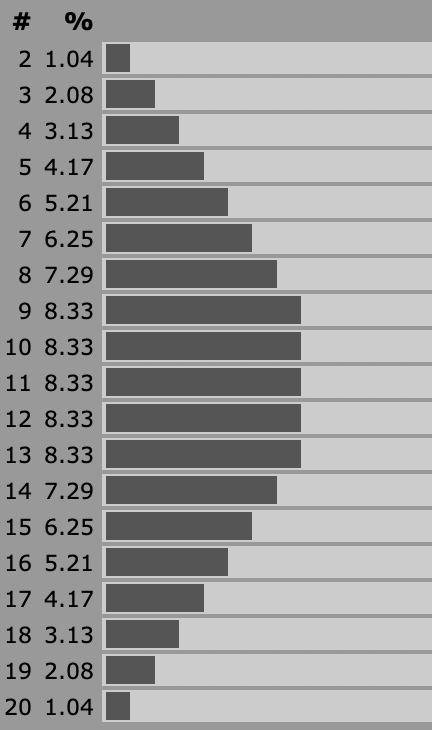
Distribution: I was playing around with the distribution results for different combinations of dice on anydice.com and found that a d8 plus a d12 resulted in an interesting distribution that yielded 19 outcomes - as in the image at left.
I said to myself, that would work very well for a random monster distribution! Why on Earth does the game use a single d20 and give everything equal opportunity? Then by chance I noticed in the back of my ancient Monster Manual II that in fact the original authors of Dungeons and Dragons had made the same discovery, and had spelled the whole thing out very nicely (though with a raft of typos, oddly).
So I'd re-invented the wheel a bit. No matter, it would help with the distribution issue.
New creatures and their ecology: The original game seems designed to ensure continuous combat a host of monsters of various designs that are all motivated by the same few things: hunger, hatred, or insanity. Where are the cunning creatures or those just trying to get by - ones with whom a variety of different possible responses to meeting a party of humanoid adventurers? Where are the details of how these species must live that they'd be encountered in some abandoned mine-shaft or cavern or "dungeon"?
I started inventing new species, merging redundancies (e.g. goblin/hobgoblin/bugbear, skeleton/zombie/ogre skeleton/ogre zombie), eliminating duplicates (e.g. orcs, most of the dragon "species"), rationalizing ecologies (e.g. underground saprophyte, lizardman swamplands), and rebalancing the mix to keep real odd-balls (xorn, minotaur, oozes) to a minimum while predator-prey pyramids were clear.
My random monster tables are available for download as Excel and PDF files. You'll need Labyrinth Lord, or the old "B/X" games plus the MMII, and whatever online source you can find for the "grick". Use these tables one rolls the d8/d12 combination outlined at the top of this page.